META'S LLAMA IS EATING THE INTERNET
Statista dropped a chart that should make every content creator, every redditor, every person who ever posted a recipe online feel a little violated: Meta's Llama AI models are consuming data at a scale that makes previous AI training runs look like light snacking.
Remember when Llama 1 leaked in February 2023? A "research-only" 65-billion-parameter model that got dumped on 4chan within days of release. Quaint. Adorable. That model was trained on roughly 1.4 trillion tokens — which sounded insane at the time. Now? That's appetizer territory. That's the bread basket before the main course. That's the thing you eat while staring at the menu.
Fast forward 18 months. Llama 3.1 dropped July 23, 2024 with a 405-billion-parameter flagship — the biggest open-weights model ever released — and it chewed through 15 trillion tokens during training. Fifteen. Trillion. That's approximately every coherent English sentence ever written by humans, compressed, duplicated, shredded, and force-fed into a GPU farm so massive it reportedly required over 16,000 H100 GPUs running for months. NVIDIA made roughly $480 million off that single training run at current H100 pricing. Jensen Huang is laughing all the way to the bank while Mark Zuckerberg is laughing all the way to your data.
And Meta's not done. Llama 4 is already cooking, and the whisper network says the training data budget is doubling again. Because here's the dirty secret of the AI arms race that Statista's chart makes blindingly clear: the models aren't getting dramatically better because someone discovered new math. They're getting better because we're throwing exponentially more data and compute at the same transformer architecture from 2017.
The hunger isn't a bug. It's the entire strategy.
THE DATA WALL IS REAL AND IT'S COMING FOR EVERYONE
Here's where it gets grim for the "AI will solve everything" crowd. The internet is finite. High-quality human-generated text? Even more finite. Estimates from researchers at Epoch AI suggest we could exhaust the global stockpile of high-quality text training data sometime between 2026 and 2028. That's not distant sci-fi timeline. That's two product cycles away. That's next Tuesday in tech years.
Meta knows this. That's why they've been caught scraping:
- Every public Instagram post and caption since the platform's inception. Your vacation photos from 2013? Training data now.
- Every Facebook comment since around 2014. Every political meltdown, every birthday wall post, every relationship-status change announcement.
- Every public Reddit thread they could grab before Reddit locked down their API in July 2023 and started charging $12,000 per 50 million requests.
- Books3, a shadow library of thousands of copyrighted published books. The Authors Guild is already circling with lawsuits.
- Transcripts from every podcast, every YouTube video with captions, every publicly accessible audio file.
The "open source" crowd celebrates Llama as the democratic alternative to OpenAI's walled garden and Anthropic's pay-to-play Claude. Cool story. But Llama is only "open" in the sense that Meta gives away the final model weights after vacuuming up everyone's intellectual property without consent or compensation. You get the model for free. They got your content for free. That's not democratization. That's a barter system where only one side knew they were trading.
THE NUMBERS DON'T LIE, THEY JUST STARE AT YOU COLDLY
Let's put the data hunger in perspective with the model progression, because the numbers are genuinely staggering:
Llama 1 (February 2023): 1.4 trillion training tokens, up to 65B parameters. Labeled "research only" with a straight face until it leaked.
Llama 2 (July 18, 2023): 2 trillion tokens, up to 70B parameters. Released "commercially open" after the leak made restrictions pointless. Also the first Llama with RLHF fine-tuning.
Llama 3 (April 18, 2024): 15 trillion tokens, 8B and 70B parameter variants. A 7.5x data jump in a single generation. That's not iteration. That's escalation.
Llama 3.1 (July 23, 2024): Same 15T tokens, now scaled up to 405B parameters. The largest openly available model on planet Earth.
Notice the pattern? The parameter count climbs steadily, but the data climbs like a rocket strapped to a rocket. Meta's entire bet is clear: more data wins. Quality matters, sure, but quantity has a quality all its own. It's the Stalin approach to machine learning. Quantity has a quality all its own, except instead of T-34 tanks it's tokens scraped from your aunt's Facebook rants about vaccines.
And it kind of works. Llama 3.1 405B genuinely competes with GPT-4o on benchmarks. It scored 88.6 on MMLU, 86.5 on GSM8K math reasoning, and trades blows with Claude 3.5 Sonnet on coding evaluations. For an "open" model, that's remarkable. For the internet that got consumed to build it, that's deeply concerning.
SO WHAT HAPPENS WHEN THE BUFFET RUNS OUT?
Here's the thing nobody at Meta's Menlo Park PR office wants to acknowledge: the data hunger is about to hit a physical wall, and nobody has a plan that doesn't involve one of three increasingly desperate strategies.
Option A — Synthetic data. Models train on outputs from other models. This works for a while, then you get "model collapse" — the AI equivalent of a photocopy of a photocopy of a photocopy until the text becomes meaningless noise. Researchers from Oxford, Toronto, and Rice published a paper in Nature proving this happens. It's not theoretical. It's mathematical certainty.
Option B — Just steal more, harder. Meta's already being sued by Sarah Silverman, by the Authors Guild, and a class action of thousands of copyright holders. The legal strategy appears to be: settle years later for pennies, keep training now. The penalties will be rounding errors on a $1.5 trillion market cap.
Option C — Actually pay content creators for their work. Pause for laughter. This is Silicon Valley. "Paying for content" is so Web 2.0. Why pay when you can scrape?
THE STREET-LEVEL REALITY CHECK
Here's the bottom line for anyone not writing AI policy white papers: every word you've ever posted online is now part of the world's largest unpaid training dataset. Meta didn't ask. They didn't have to. Their terms of service had you agree to it when you clicked "accept all" sometime during the Obama administration without reading a single sentence.
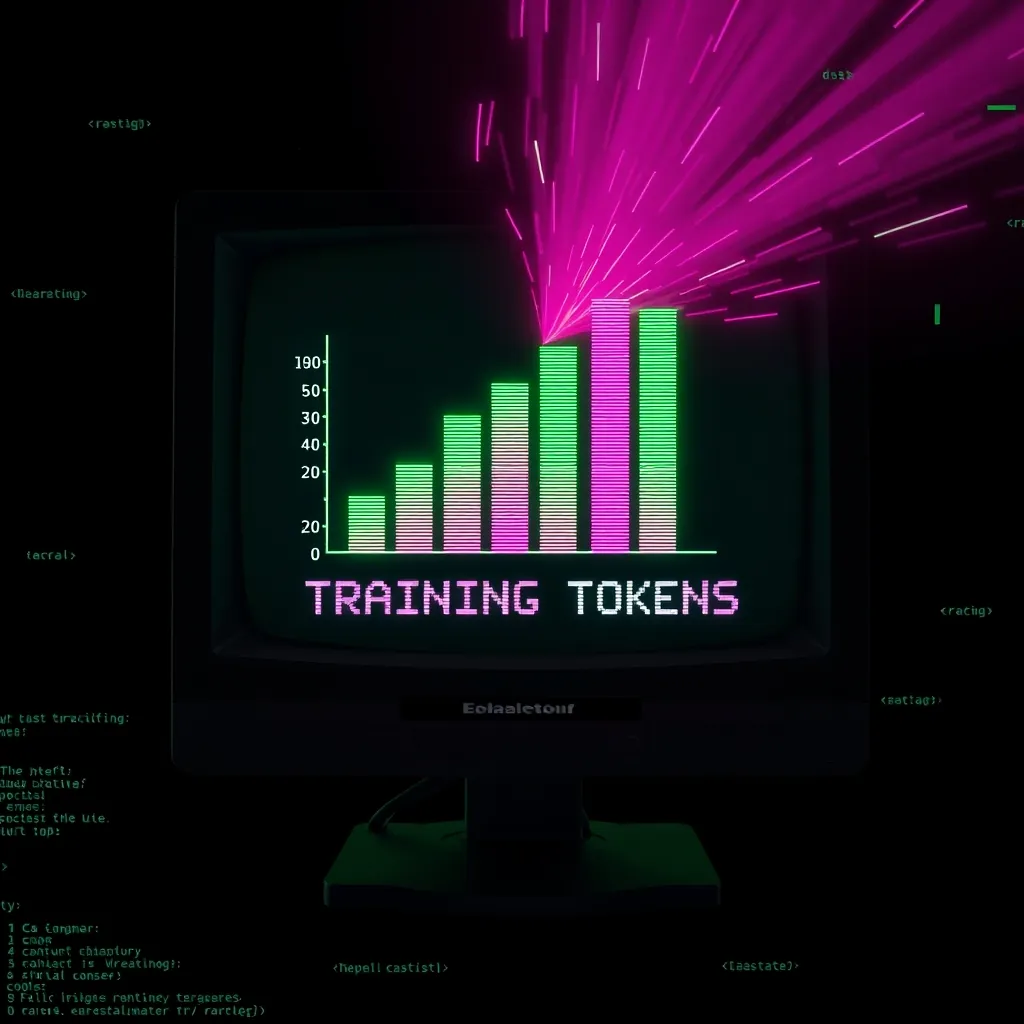
Your tweets, your restaurant reviews, your heated comment-section arguments about whether a hot dog is a sandwich — all of it got ground into the sausage. And Llama 5? It's going to be hungrier. Statista's data visualization shows the exponential curve bending upward, and there's zero reason to believe it plateaus. Meta needs more. Always more. The llama is never full.
The open-source crowd will keep cheering because they get free weights to build their Y Combinator startups. The closed-source giants — OpenAI, Anthropic, Google — will keep pretending their data pipelines are somehow more ethical while doing the exact same thing behind thicker NDAs. And you? You'll keep generating data. Every post, every search, every voice memo, every Apple Watch heartbeat if they can figure out how to tokenize it.
The llama eats. The internet feeds it. Nobody's getting paid except NVIDIA, who sold 16,000 GPUs at roughly $30,000 each for one training run.
Welcome to the data economy, round two. You're the product. You're also the raw material, the factory floor, and the waste dump. And the machine's still hungry.