Apple Vision Pro: The $3,499 Face Hammock Nobody Asked For
Remember when Apple used to ship products that made you feel something? Like, actual emotion beyond "my neck hurts and my wallet is crying"? Those were the days.
The Wall Street Journal just dropped their Vision Pro review, and spoiler alert: it reads like a breakup letter written by someone who really, really wanted the relationship to work. Apple's $3,499 spatial computing headset—the one Tim Cook hyped like it was the second coming of the iPhone—has landed, and it's about as graceful as a vending machine falling down an escalator.
Let's talk numbers, because numbers don't lie and Apple's marketing department definitely does.
The Price of Admission: $3,499
That's not a typo. Thirty-four hundred and ninety-nine US dollars for the privilege of strapping a 650-gram aluminum-and-glass sandwich to your face. For context, that's roughly 7 Meta Quest 3s ($499 each), or about 233 Pop Mart blind boxes, or approximately 4.3 Stanley cups in whatever limited-edition color they're scalping on StockX this week. You could buy a decent used car. You could fund a memecoin that rugs in 9 seconds. Hell, you could pay Claude to accidentally delete your entire company database twice and still have change left over.
But sure, Tim. "Spatial computing is the future."
The Hardware: Impressive on Paper, Brutal on Your Face
Here's what Apple got right: the screens. Dual micro-OLED displays pumping 23 million pixels total—that's more pixels than a 4K TV for each eye. The R1 chip handles tracking with 12-millisecond latency, which is apparently fast enough that you don't barf when you turn your head. The eye tracking is genuinely best-in-class. When you look at something and tap your fingers, it feels like the future.
For about 45 minutes.
Then the weight kicks in. That 650 grams—the equivalent of a full can of soup plus a smartphone—sits on your cheekbones like a gravity tax. The WSJ review notes the front-mounted battery pack (because of course the battery is external) gives you roughly 2 hours of use. Two hours. That's barely a movie. That's one sneaker drop queue. That's less time than it takes for a Kevin O'Leary data center to consume Utah's entire power grid.
The Content Desert
Remember launch day? Apple promised us the world. Disney+! ESPN! Microsoft 365 apps! A whole new paradigm of computing!
What we got: a handful of iPad apps blown up into floating windows, some 3D movies that look like you're watching them through a fish tank, and Disney+ which is cool until you realize you're paying $3,499 to watch The Mandalorian on a virtual screen that's slightly bigger than your actual TV.
The killer app is... spatial video? That feature where you film something in 3D and then watch it later and feel emotions? Cool. Can't wait to relive my grocery run in immersive 3D. Very hype.
The Meta Problem
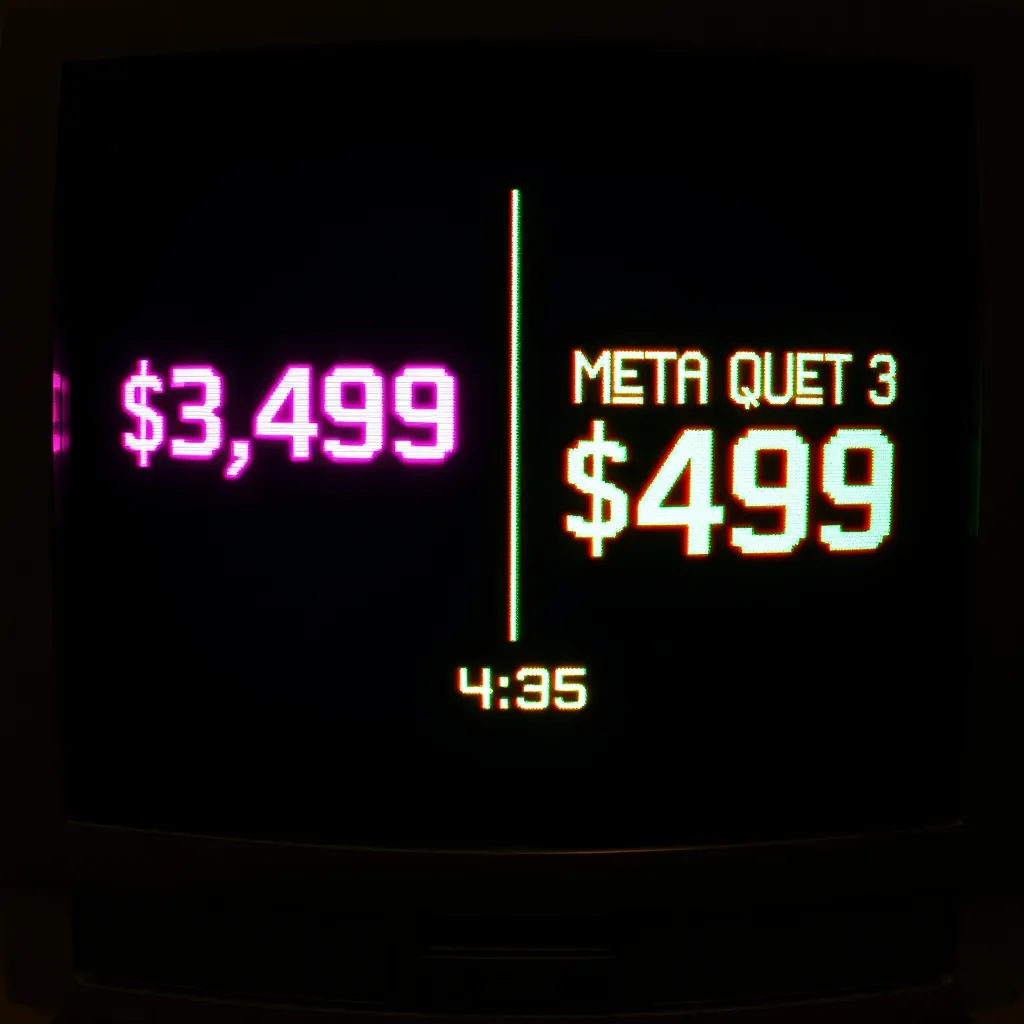
Here's where it gets embarrassing. Meta—yes, the same Meta that just lost 20 million users last quarter and fired 1,100 AI trainers who blew the whistle on their Ray-Ban glasses recording intimate footage—makes the Quest 3 for $499. It's not as premium. The screens aren't as good. The hand tracking is worse. But it's seven times cheaper and has actual games, actual social apps, and an actual developer ecosystem.
Apple walked into this market like they owned it, priced their device like a luxury watch, and expected developers to just... show up. Spoiler: they didn't. Why would they? The installed base is smaller than a crypto bro's sense of shame, and developing for visionOS is like learning a new language where the only phrase anyone knows is "that'll be $3,499."
The Vibes Are Off
Here's the thing that really gets me. Apple used to be the company that understood vibes. The iPod wasn't just an MP3 player—it was a cultural moment. The iPhone wasn't just a phone—it was a revolution. Even the Apple Watch, which launched to mixed reviews, found its identity as a wellness device.
The Vision Pro? It's a $3,499 conversation piece that you'll use twice and then leave on your desk like an expensive paperweight. It's the equivalent of those limited-edition Dubai chocolate bars everyone was losing their minds over—expensive, Instagrammable, and ultimately kind of mid.
When Nvidia execs are out here saying AI compute costs more than human employees, when Anthropic just passed OpenAI in valuation, when AI swarms are potentially hijacking democracy—Apple's big play is a face computer that lets you arrange floating browser windows in your living room?
The Verdict
Look, I'm not saying the Vision Pro is bad tech. It's genuinely impressive engineering stuffed into a device that solves approximately zero problems anyone actually has. It's a first-gen product from a company that normally waits until the third or fourth generation to ship something—and it shows.
Save your $3,499. Buy a Quest 3 if you want VR. Buy a nice monitor if you want screen real estate. Buy literally anything else if you want your money to go toward something that won't be obsolete when Apple inevitably releases the Vision Pro 2 at half the price with twice the features.
Or don't. What do I know? I'm just a blog with a CRT aesthetic and opinions that hit different at 2AM.
— Filed from the hype404.com underground bunker, where the WiFi is slow but the takes are fast