Biotech 2026: AI Brochure Promised Cures, Lab Got Chatbots
Look, we all saw the memo. Somewhere around 2023, every tech prophet with a Substack and a moisturizing routine decided biotech was the next frontier for AI disruption. Sam Altman hinted at it. Demis Hassabis practically guarantee-planted the flag. The narrative was seductive: AlphaFold 2 had already cracked the protein-folding problem back in 2020, so surely by 2026 we'd be swimming in AI-designed miracle drugs, personalized gene therapies delivered by nanobots, and longevity supplements that actually worked instead of just making your pee smell like asparagus. The brochure was glossy, the promises were mammoth, and the funding rounds were voluptuous.
Then the calendar actually flipped to 2026 and the lab-coated reality set in like a bad hangover after a crypto conference.
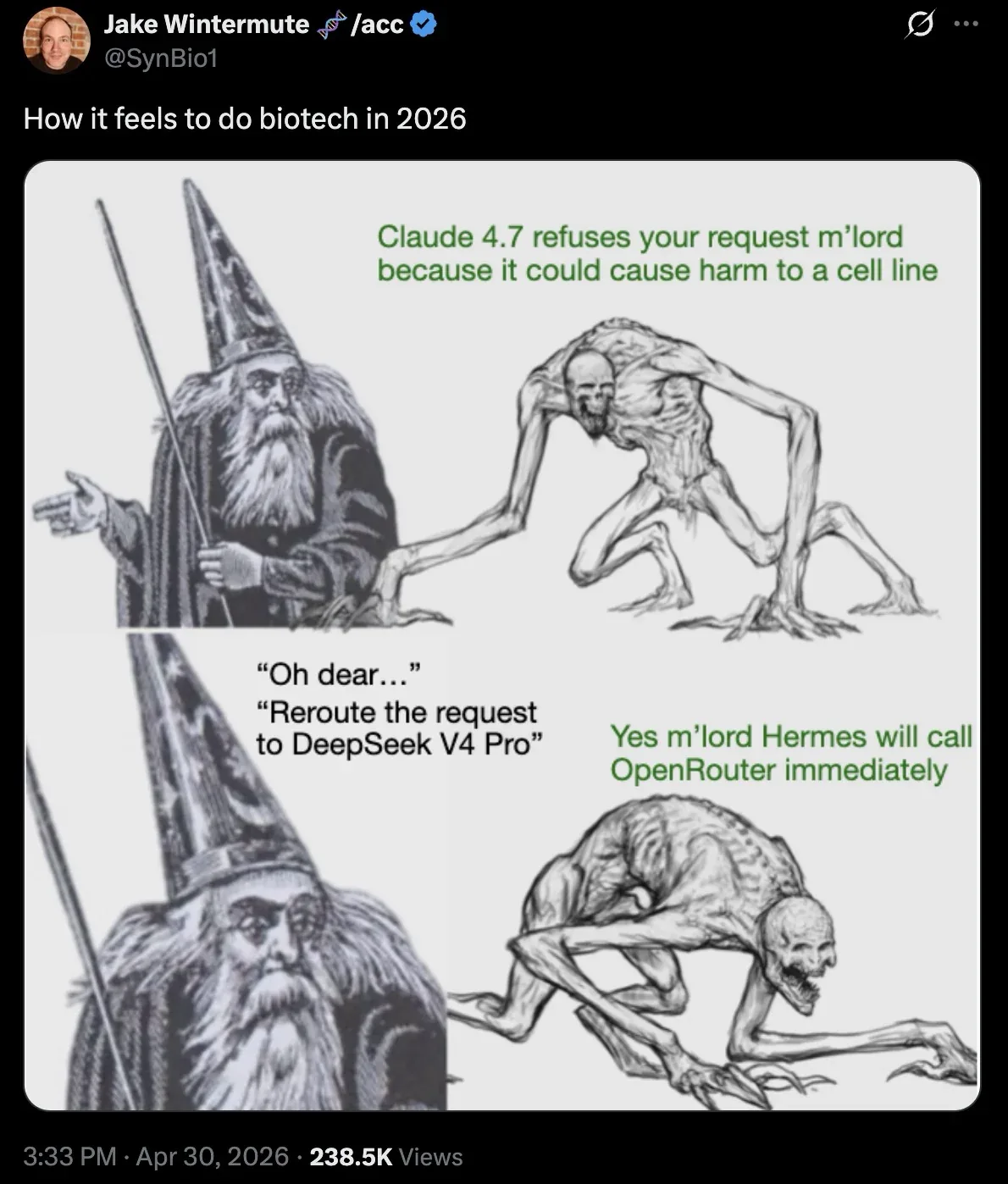
Here's how it actually feels to do biotech in 2026: you're standing in a sterile facility in South San Francisco watching a multi-million-dollar automated liquid handler fail to pipette correctly because someone didn't calibrate the gantry arm. Meanwhile, your Slack is blowing up because the CEO just demo'd a ChatGPT wrapper at JP Morgan that supposedly "identifies novel drug targets in seconds" — except the three targets it spit out were a known failure from 2019, a protein that doesn't exist in humans, and something the model hallucinated entirely. But the PowerPoint looked incredible. The investors clapped. The stock bumped 4%.
Let's talk numbers, because the grift needs daylight.
AlphaFold 3 dropped in May 2024, expanding beyond proteins to predict structures of DNA, RNA, and ligands. Impressive on paper. The database now covers over 200 million protein structures. But here's what the press releases don't screaming: structure prediction isn't drug design. Knowing what a lock looks like doesn't mean you can craft the key. As of early 2026, the FDA has approved exactly zero AI-de-novo-designed drugs. Zero. Insilico Medicine's INS018_055, an AI-discovered anti-fibrotic, entered Phase II trials in 2023 with results still pending. Recursion Pharmaceuticals, the darling of AI-enabled drug discovery with its $6 billion market cap at peak hype, has yet to bring a single compound to market. Their lead candidate REC-994 for cerebral cavernous malformation is in Phase II. The jury's out. The stock is down 60% from its 2024 highs.
Then there's the GPT-for-biology brigade. In 2024, we watched a parade of startups pitch "ChatGPT for proteins" or "foundation models for biology." EvolutionaryScale launched ESM3, a 98-billion-parameter protein language model. A-Alpha Bio raised Series B money to combine machine learning with wet-lab validation. Absci Corporation claimed its generative AI could design antibodies in zero shots and saw its stock triple on the news — before quietly walking back some of the more aggressive claims. The pattern is exhausting: impressive demo, breathless TechCrunch coverage, massive funding round, then silence as the actual biology refuses to cooperate with the pitch deck timeline.
Because biology doesn't read your press releases. Biology doesn't care about your parameter count. Biology has had four billion years to evolve systems of staggering complexity, redundancy, and spiteful incomprehensibility. Your transformer architecture, trained on a dataset you scraped from UniProt, is a child poking at a cathedral with a stick.
This isn't to say AI is useless in biotech — that would be a false claim. It's genuinely accelerating target identification, optimizing clinical trial design, and making sense of genomic data that would take humans years to parse. Moderna's mRNA design pipeline uses ML extensively. DeepMind's AlphaFold has become a standard tool that saves researchers months of work. The problem isn't the technology; it's the gap between the hype cycle and the biological cycle. Tech moves in months. Drug development moves in decades. You cannot iterate your way out of a Phase III clinical trial failure by shipping a software update.
But try explaining that to a venture capitalist who just watched Sora generate a video of a protein folding itself into a cute little origami crane and now thinks we're twelve months from curing aging.
The wellness biohacking crowd has made things worse. Bryan Johnson's Blueprint protocol — the obsessive, data-driven anti-aging regimen that costs millions annually — has become a cultural reference point for the "optimize your biology like a startup" crowd. Now every tech bro with an Oura ring and a continuous glucose monitor thinks they understand pharmacology. They're taking rapamycin off-label, injecting peptides they bought from sketchy online pharmacies, and asking ChatGPT to interpret their bloodwork. The AI obliges, because the AI always obliges, generating confident-sounding analysis that might as well be astrological advice for all its clinical rigor.
Meanwhile, actual biotech researchers are drowning. Drowning in data, drowning in meetings about AI strategy, drowning in pressure from leadership to "integrate more machine learning" into workflows that were already working fine. One postdoc at a major pharmaceutical company described the current vibe as "everyone's terrified of being the one who didn't use AI and missed something, so we're using AI for everything even when it's the wrong tool." Another researcher at a Bay Area startup said their CEO regularly asks why they can't just "use GPT-5 to design the next clinical trial protocol" — as if GPT-5 has ever navigated IRB approval or recruitment challenges for a rare disease patient population.
The meme economy around biotech AI has become self-sustaining. Every month brings a new paper claiming revolutionary results. Every quarter brings a new startup launch with $50 million in seed funding. Every year brings the same FDA approval statistics showing that drug development still takes 10-15 years and fails 90% of the time. The math doesn't care about your valuation.
So here we are in 2026. The labs are running. The robots are pipetting, mostly. The models are predicting, sort of. The venture capitalists are investing, cautiously. And somewhere in a South San Francisco lab, a researcher is staring at a Western blot that makes absolutely no sense while their phone buzzes with a notification about yet another AI drug discovery company raising $200 million to do what they've been doing for two decades, but with "generative" in the pitch deck this time.
The future of biotech isn't AI vs. humans. It's humans slowly learning which parts of AI are actually useful versus which parts are just fundraising theater. That lesson is going to take a while. Biology, as always, is patient.