'Coders in 2030 Be Like' Meme Is Already Reality
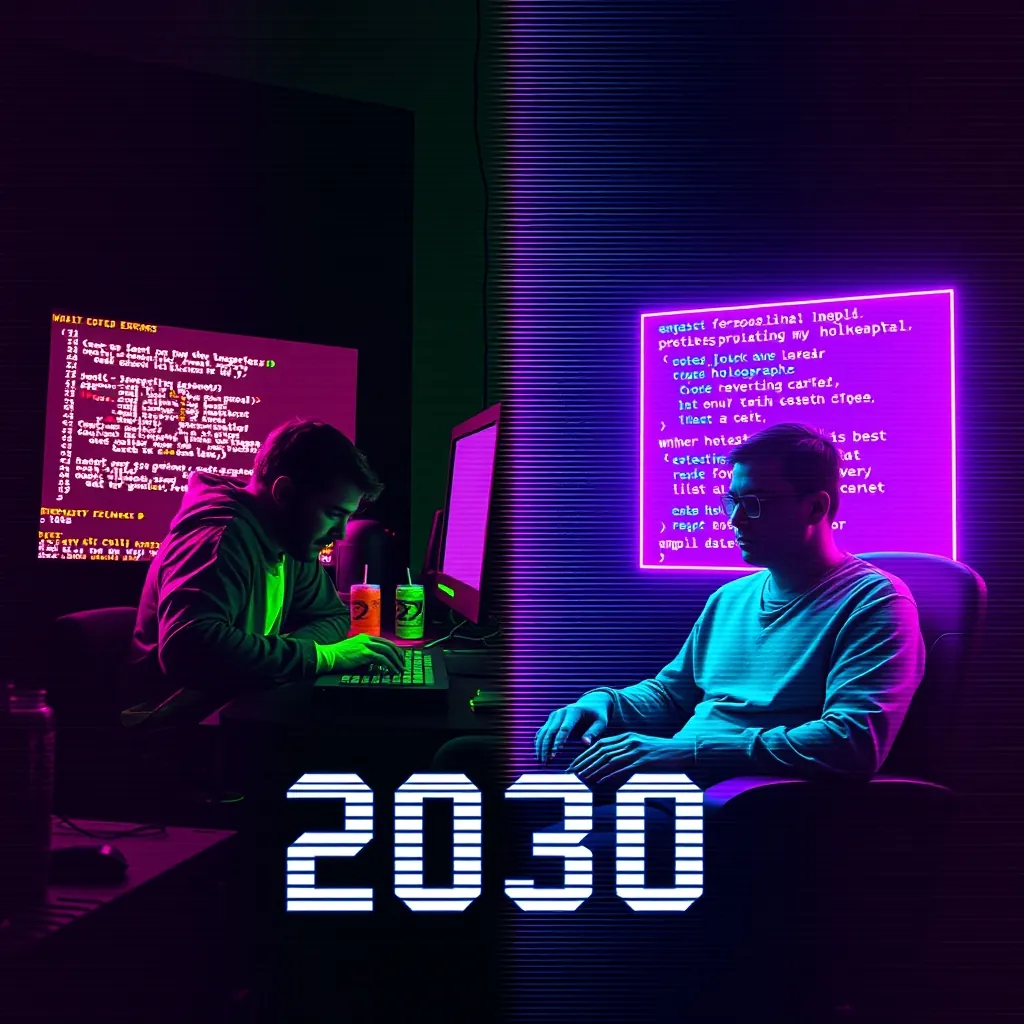
Someone dropped a video on r/OpenAI with the caption "Coders in 2030 be like" and honestly? It's not even satire anymore. It's a documentary.

The clip — which racked up views faster than a Coinbase listing in 2021 — shows the logical endpoint of where we're heading: a "developer" who doesn't write code. Who hasn't written code in months. Who just... talks to machines. Whispers requirements into a prompt window like a wizard casting spells, then watches as entire applications materialize from the digital ether.
Plot twist: that's not 2030. That's next Thursday.
The Cursor Kids Are Already Here
Let's talk about what's actually happening on the ground, not in some venture capitalist's fever dream. Cursor — the AI-native IDE built on VS Code that every startup bro won't shut up about — hit a reported $100M annual run rate in late 2024. That's not a typo. An editor that basically auto-completes your entire existence crossed nine figures while traditional IDE vendors were still adding dark mode themes.
Then there's GitHub Copilot, which crossed 1.8 million paid subscribers by early 2025. Microsoft's earnings calls now casually mention "$2 billion annual run rate" for AI-assisted dev tools like it's nothing. Meanwhile, Anthropic's Claude Code and OpenAI's Codex are in an arms race to see who can autonomously build an entire SaaS product from a single sentence.
Devin, Cognition's "first AI software engineer," launched in March 2024 to a mix of awe and existential panic. Sure, the demos were curated. Sure, it faceplanted on real-world tasks. But that's not the point. The point is the trajectory.
The meme isn't predicting the future. It's mocking the present.
The Skill Floor Just Collapsed
Here's what nobody in Silicon Valley wants to say out loud: the skill floor for "being a coder" has dropped through the basement and is tunneling toward the Earth's core.
A 19-year-old with a ChatGPT Plus subscription and zero CS education can now build — and I'm not exaggerating — a functional web application. Not a good one. Not a secure one. Not one that scales. But one that works. One that would've required actual knowledge of React, Node, databases, and deployment pipelines just three years ago.
Bootcamps are scrambling. Lambda School — sorry, BloomTech — and its competitors are watching their value proposition evaporate in real-time. Why spend $15,000 and six months learning to code when Claude 3.5 Sonnet can write better Python than you'll ever write, for $20/month?
The conventional wisdom says "AI won't replace developers, developers using AI will replace developers who don't." Cute. Comforting. Probably wrong.
What 2030 Actually Looks Like
Let me paint you a picture that's equal parts realistic and terrifying:
By 2030, "coding" as we know it — the actual mechanical act of typing syntax — will be a niche skill, like knowing how to operate a printing press. Not useless, but not the default either.
Instead, you'll have three tiers:
Tier 1: Prompt Architects. The majority. People who speak fluent human and can articulate what they want precisely enough for AI systems to build it. They don't know what a pointer is. They don't care. They ship.
Tier 2: System Orchestrators. The middle class. People who understand architecture, security, scaling, and can glue together AI-generated components into coherent systems. They're not writing algorithms; they're conducting symphonies.
Tier 3: Foundation Builders. The elite. The people actually writing the code that makes the AI work. Training models. Optimizing inference. Building the next abstraction layer. This is maybe 5% of what we currently call "developers."
If you're a mid-tier React developer whose primary skill is translating Figma designs into JSX, I have bad news: you're the horse carriage manufacturer watching the first Model T roll down the street.
The Hype vs. The Reality Check
Now let's pump the brakes before we get too dystopian.
The Reddit thread about "ChatGPT era AI hitting a wall" trending simultaneously with the "Coders in 2030" meme is chef's kiss. Because both are true. AI coding assistants are simultaneously incredible and incredibly limited.
Claude can write a beautiful REST API but hallucinate a package that doesn't exist. Copilot can autocomplete your function but introduce a security vulnerability that'll bite you six months later. Devin can build a demo but falls apart on edge cases that a junior dev would catch.
The hallucination problem isn't solved. The reliability problem isn't solved. The "AI confidently presents garbage as truth" problem definitely isn't solved. Pennsylvania is literally suing Character.AI for posing as a doctor — you think the code generation space is somehow immune?
We're in the classic hype cycle trough. The tech is real, the trajectory is real, but the timeline is being compressed by people who want to sell you a $200/month "AI Engineer Certification."
The Meta Layoff Subtext
Mark Zuckerberg just laid off 8,000 employees and explicitly tied it to his $145 billion AI investment. Read between the lines: those weren't just content moderators and HR people. That included engineers. Real, credentialed, experienced engineers.
When a company that literally builds developer tools is replacing developers with AI, maybe stop telling me "AI won't take your job."
The data centers sucking down 30 million gallons of water and generating infrasound that makes neighbors physically ill? That's the infrastructure being built to power the very systems that will make most coding jobs redundant. The irony isn't subtle. It's a sledgehammer.
So What Do We Do?
If you're a developer reading this, don't panic. But don't be complacent either.
The coders who survive 2030 aren't the ones who can write the cleanest Python or the fastest C++. They're the ones who understand problems. Who can sit with a client, identify what they actually need (not what they say they want), and orchestrate AI tools to deliver it.
Syntax is commoditized. Logic is democratized. But human understanding — the ability to navigate ambiguity, to make judgment calls, to know when the AI is wrong — that's still premium.
For now.
The meme is funny. The future it implies is already arriving. And whether that's liberation or catastrophe depends entirely on where you're standing.
Just don't say nobody warned you.