DuckDuckGo Surges 30% as Google Force-Feeds AI Search
The natives are restless. And they're flocking to DuckDuckGo like it's 2013 all over again.
In what might be the most satisfying middle finger to Big Tech hubris since... well, since last week's whatever-it-was, DuckDuckGo just reported a 30% surge in installs. The reason? Users are absolutely done with Google force-feeding them AI-generated search summaries nobody asked for.
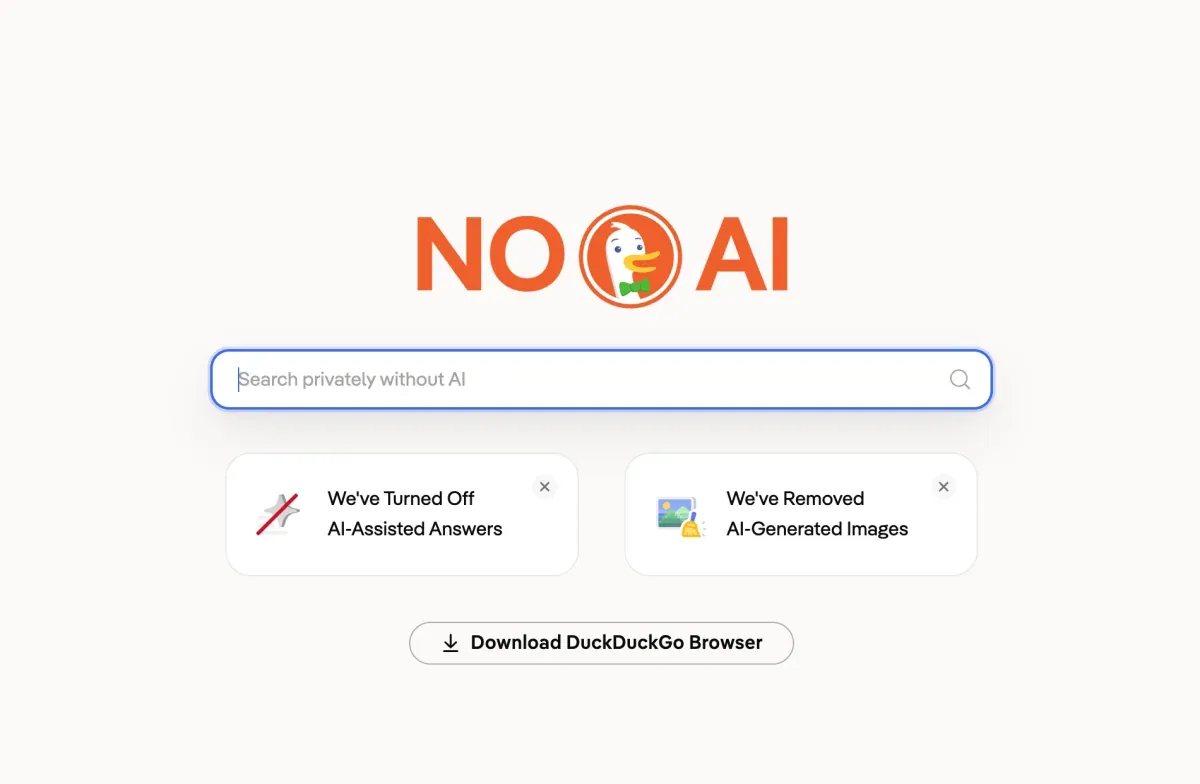
Let's rewind the tape. Google AI Overviews — formerly Search Generative Experience, formerly 'that thing they rushed out after Bing briefly threatened them' — went fully mainstream in May 2024. The promise was tantalizing: AI would do the searching for you, synthesizing answers from across the web into neat little summary boxes.
The reality? A glitchy, hallucination-prone mess that told people to eat rocks, put glue on pizza, and drink urine for kidney stones. Classic Google energy — ship it broken, apologize later, call it innovation.
By early 2025, AI Overviews were appearing on over a billion queries daily. Google, drunk on its own Kool-Aid and desperately trying to justify the rumored $100+ billion they've burned on AI research, made the summaries virtually impossible to disable. They embedded them in results. They expanded them. They started replacing actual blue links with AI-generated waffle.
And the people? The people said 'nah.'
The backlash built slowly, then all at once. Reddit threads complaining about Google's AI search went viral weekly. 'How to turn off Google AI' trended repeatedly. Power users migrated. Normals grumbled. And DuckDuckGo — that quirky little search engine with the duck mascot that privacy nerds have been hyping since the Snowden era — suddenly became the lifeboat.

Thirty percent installation growth. Let that sink in. For a search engine that's been stuck around 2-3% market share for years, that's not just a blip. That's a movement.
But here's what's really interesting, and what the TechCrunch crowd won't tell you: this isn't just about privacy anymore. This is about user agency. About the fundamental right to search the internet without some algorithmic middleman deciding what you 'really' want to know.
Google's AI Overviews aren't just annoying — they're epistemologically dangerous. When an AI summarizes information, it necessarily flattens nuance. It makes editorial decisions about what's 'relevant.' It hallucinates with the confidence of a crypto bro explaining blockchain to his grandmother. And most critically, it steals traffic from the actual websites that produced the information in the first place.
Sound familiar? It should. It's the same extractive playbook Google's been running for two decades — first with Featured Snippets, then with Knowledge Panels, now with AI Overviews. Take other people's work, summarize it, serve it up as your own, watch the ad revenue roll in.
Only now they've added a probabilistic parrot to the mix. What could go wrong?
The DuckDuckGo surge is part of a broader rebellion against forced AI integration. Substack writers are bragging about going AI-free. Artists are watermarking their work with 'human-made.' There's a growing 'analog luxury' movement where paying for things without algorithmic interference is becoming a status signal.
We're entering the 'raw water' phase of AI adoption — where the overcorrection to techno-optimism becomes its own kind of pretentious counterculture. But unlike drinking unfiltered Brooklyn spring water, avoiding hallucinating search engines might actually be... smart?
DuckDuckGo isn't perfect. Their results can feel thin compared to Google's index. Their 'AI Chat' feature — because of course they launched one, everyone did — is opt-in rather than forced. Their privacy story got slightly muddied a few years back when researchers found some tracking exceptions. The duck is cute but the product remains... fine. Just fine.
But 'fine' is looking pretty good when the alternative is being told to add non-toxic glue to your pizza sauce by a trillion-dollar company that can't figure out why people are mad.
The real question isn't whether DuckDuckGo can sustain this growth. History suggests they can't — they've had spikes before (Binggate 2023, various privacy scandals) and always settled back to their baseline of dedicated privacy adherents and people who changed their default search engine once and forgot about it.
The real question is whether this moment crystallizes something larger: a genuine consumer revolt against ambient AI. Not against AI in principle — people love ChatGPT when they choose to use it. Against AI that's forced into every interaction, every search, every device, every moment of digital life without consent or alternative.
Google's not alone in this arrogance, of course. Microsoft's Copilot appears in Windows like an uninvited party guest. Apple's Intelligence is coming for every iPhone whether you want it or not. Meta's shoving AI chatbots into WhatsApp like it's a fire sale on synthetic conversation.
But Google is the most vulnerable to backlash because search is supposed to be neutral. A portal. A tool. When the tool starts talking back — badly — the utility collapses.
So here's to the duck. May your installs continue climbing. May Google's AI Overviews continue hallucinating themselves into irrelevance. And may we all eventually get through a single Google search without being told to eat rocks.
The people want their blue links back. Is that really so much to ask?