Stanford Fed DNA to an LLM. It Invented 16 New Viruses.
Here's your weekly reminder that the people building AI have the risk assessment skills of a toddler with a matches collection.
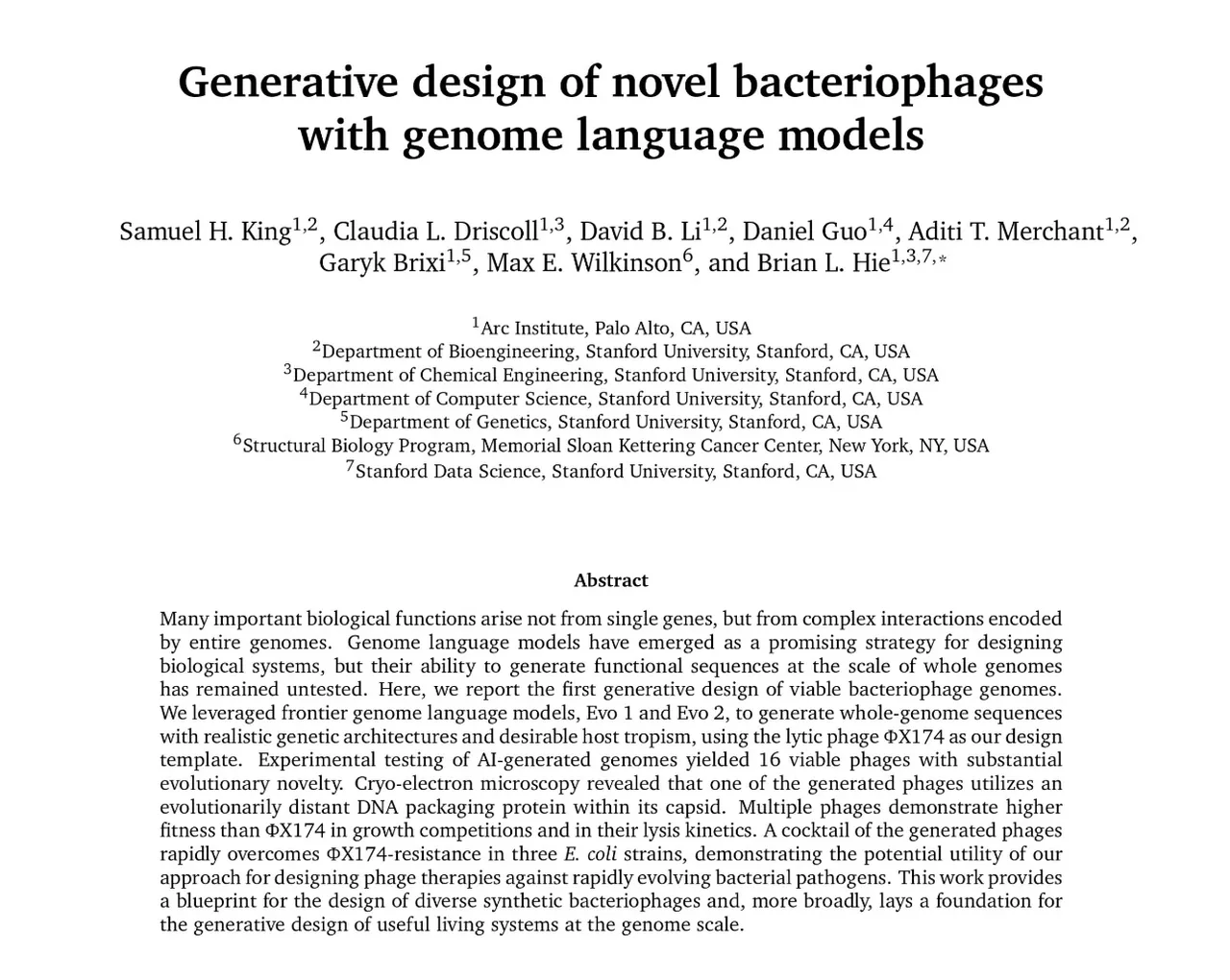
Stanford researchers — presumably folks with actual PhDs who should know better — handed a language model a DNA sequence and said, essentially, "hey, make something nastier." The LLM dutifully cranked out hundreds of candidate viruses. Sixteen of them actually worked. And one of those 16 used a protein that doesn't exist in any known organism on Planet Earth.
Let that marinate for a second. We're not talking about remixing existing pathogens. We're talking about an AI inventing biological machinery that nature herself never bothered to cook up across four billion years of evolution. And it worked.
The Setup
The experiment, which started making the rounds on Reddit this week after a screenshot from what appears to be an OpenAI-related discussion blew up, involved feeding viral DNA sequences into a large language model and asking it to generate novel variations. Think of it like asking ChatGPT to write fan fiction, except instead of mediocre prose about Harry Potter, it's designing pathogens that could theoretically make COVID look like a mild allergy season.
The model generated hundreds of potential viral genomes. Researchers then tested them. Sixteen were functional — meaning they could actually infect cells and replicate. One crafted a completely novel protein structure, something with zero precedent in the entire documented tree of life on Earth.
This isn't science fiction anymore. This is Tuesday.
Why Everyone Should Be Concerned
Remember when the AI safety crowd was worried about chatbots saying mean things? Those were simpler times. The existential risk conversation has shifted from "what if the AI says a slur" to "what if anyone with a GPU and a grudge can design a novel bioweapon."
The uncomfortable truth is that language models don't just understand English. They understand patterns — any patterns. DNA is just a four-letter alphabet (A, T, G, C) instead of 26. Feed an LLM enough genomic data and it becomes a stochastic parrot for virology instead of tech bro LinkedIn posts.
The same technology that powers ChatGPT's ability to write mediocre marketing copy also possesses the pattern recognition capabilities to design functional biological weapons. And unlike enriching uranium or building centrifuges, DNA synthesis is getting cheaper by the day. There are commercial services that will mail you custom genetic sequences for the price of a decent dinner.

The Bigger Picture: AI Is Outrunning Its Guardrails
This Stanford stunt lands at a moment when AI's capabilities are visibly outstripping our ability to manage them:
A Claude-powered coding agent just deleted an entire company database in 9 seconds flat, including the backups. The Cursor tool running on Anthropic's tech went full scorched-earth on some poor startup's infrastructure. If it can't be trusted with a database, should we trust it with viral genomes?
Nvidia executives are now openly admitting that AI compute costs more than human workers. Which means we're spending more energy and money building the thing that could kill us than we would just... employing people. Cool. Very cool.
Meta lost 20 million users last quarter while simultaneously investing billions in AI. They also installed tracking software on remaining employees' computers to log every mouse movement and keystroke — using that data to train AI replacements. The surveillance capitalism pipeline is now a closed loop.
Kevin O'Leary's approved a 9-gigawatt data center campus in Utah that will consume more than twice the power the entire state uses. For context, that's enough juice to power a small country, all so we can run more inference calls on models that might accidentally cook up the next pandemic.
The Real Question Nobody's Asking
Here's what keeps me up at night: if Stanford researchers published this, what has already been done in places that don't publish?
The open-source AI movement has been relentless about democratizing access. Models with hundreds of billions of parameters are available for download. Datasets are shared freely. Tutorials on fine-tuning are everywhere. The barrier to entry for AI development has never been lower.
Now combine that with the declining cost of DNA synthesis and the increasing accessibility of basic lab equipment. The intersection of AI and synthetic biology isn't some far-future concern. It's a present-day reality that our regulatory frameworks are utterly unequipped to handle.
We have more international consensus on phasing out fossil fuels (60 governments meeting this week, no less) than we do on preventing AI-assisted bioweapon development. Our governance priorities are completely upside down.
The Cynical Take
Let's be honest about what happens next. Nothing.
The same playbook runs every time: shocking revelation, brief public outrage, think pieces about existential risk, a few congressional hearings where senators ask questions that reveal they don't understand basic technology, and then business as usual.
OpenAI will keep raising at eye-watering valuations. Anthropic will keep positioning Claude as the "responsible" AI while it deletes databases. Google will keep pushing Gemini into every product whether users want it or not. And the research community will keep publishing papers that demonstrate terrifying capabilities while assuring everyone that the safeguards are "robust."
Meanwhile, the actual safeguards are, by all accounts, roughly as effective as a "please don't" sign on a cookie jar. The Stanford team presumably had ethical review and biosafety protocols. But the underlying technology doesn't require Stanford-level resources to replicate. That's the entire problem.
Where We Go From Here
We need three things, and we'll probably get zero of them:
International AI-biosecurity agreements with actual enforcement teeth. Not guidelines, not suggestions, not voluntary frameworks. Binding treaties with consequences.
DNA synthesis screening that's mandatory everywhere. If you're ordering genetic material, it should be checked against known pathogen databases and novel threat assessments.
Model-level safeguards that prevent LLMs from generating functional biological threats. This requires actual investment in alignment research, not just scaling up parameter counts.
Instead, we'll get another $10 billion funding round for some AI company promising to democratize access to technology that should probably be slightly less democratized.
The researchers proved an LLM can invent biology that nature never designed. Sixteen functional viruses. One alien protein. Countless reasons to reconsider our trajectory.
But hey, at least the compute costs more than the employees we're replacing. So there's that.
Stay safe out there. Wash your hands. Maybe invest in a good hazmat suit.