AMD's MI300X Benchmarked: The GPU That Could Shake NVIDIA's Throne
The Chip War Just Got Interesting
AMD's MI300X isn't just another data center GPU—it's a 153-billion-transistor middle finger aimed squarely at Jensen Huang's empire. While NVIDIA's been printing money with H100 demand and watching their market cap hit $3 trillion, Lisa Su's been cooking something genuinely threatening in the AMD labs.
The Chips and Cheese team finally got their hands on the MI300X and ran it through the wringer. Spoiler: the results are messy, fascinating, and maybe a little concerning for Team Green.
By The Numbers
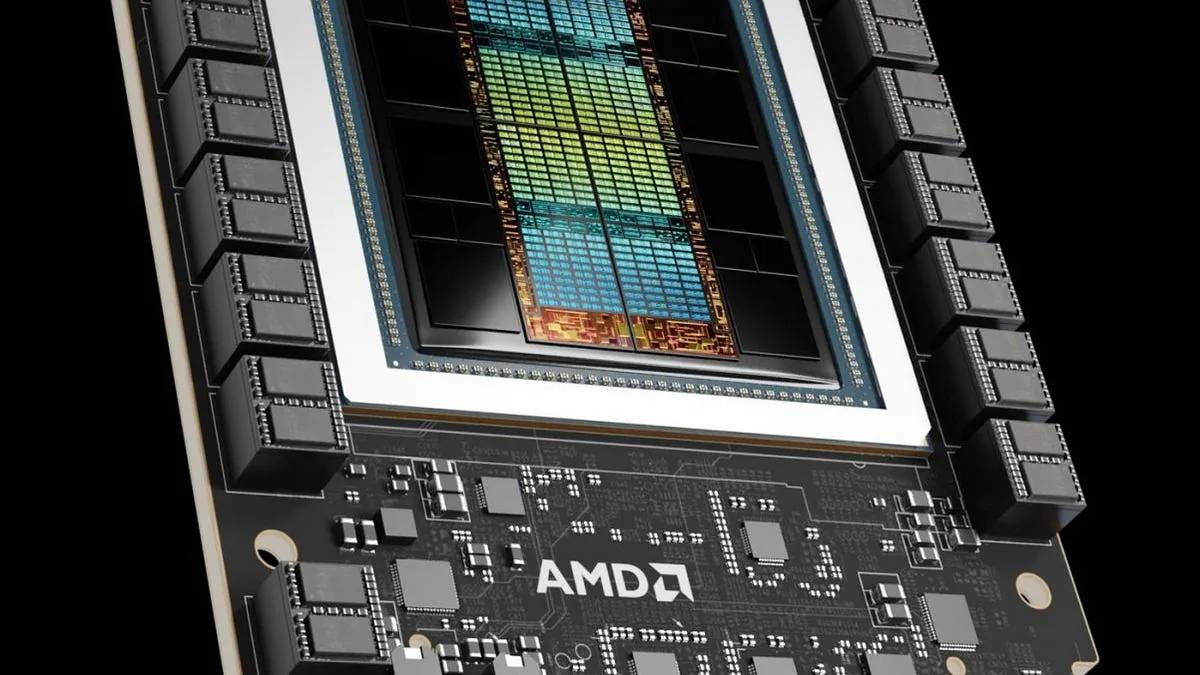
Let's talk specs first. The MI300X packs 192GB of HBM3 memory across 8 stacks, delivering 5.3 TB/s of bandwidth. That's 1.5x the memory and 1.4x the bandwidth of NVIDIA's H100. For large language models that are memory-bandwidth bound—which is basically all of them during inference—this matters enormously.
The chip uses a chiplet design that's frankly wild: 24 compute chiplets on TSMC's 5nm process paired with 6 I/O die chiplets on 6nm, all connected via AMD's Infinity Fabric. It's an engineering flex that NVIDIA hasn't attempted—they’re still monolithic for their data center GPUs.
FP16/BF16 performance? 657 TFLOPS across 19,456 stream processors. FP8? Over 1,300 TFLOPS. These numbers trade blows with or exceed the H100 depending on the workload.
The Real-World Reality Check
But raw specs are marketing material. What matters is how it runs actual workloads, and here's where things get complicated.
The MI300X shows genuinely impressive memory subsystem performance. Chips and Cheese's testing reveals the chip can sustain remarkably high bandwidth utilization during large matrix operations. For LLM inference on models like Llama 2 70B or Mixtral 8x7B, that massive 192GB frame buffer means you can fit larger models without model parallelism overhead.
But—and this is a massive but—software remains AMD's kryptonite. ROCm, AMD's compute platform, still feels like it's playing catch-up to NVIDIA's CUDA ecosystem. If you're a researcher or startup that's built your entire pipeline on PyTorch+CUDA, migrating to AMD isn't a weekend project. It's a commitment.
Why This Matters For The AI Hype Economy
Here's the thing nobody wants to admit: NVIDIA's pricing power in the AI boom is out of control. H100s are going for $25,000-$40,000 per GPU depending on configuration and availability. Some cloud providers are charging $3-4 per hour per H100. The margins are absurd.
AMD entering this market with a genuinely competitive chip isn't just a tech story—it's a potential circuit-breaker on NVIDIA's pricing monopoly. Microsoft, Meta, and others have already committed to MI300X deployments specifically because they're desperate for leverage in negotiations with NVIDIA.
Lambda Labs and other GPU cloud providers are beginning to offer MI300X instances at prices 20-30% below equivalent H100 configurations. If the performance is genuinely competitive—and these benchmarks suggest it often is—that price gap becomes impossible to ignore.
The Chiplet Gamble
AMD's chiplet approach deserves attention beyond just the MI300X. If AMD can get good yields and scale production efficiently, they could have a cost advantage that NVIDIA's monolithic designs can't match. Chiplets mean you can mix and match known-good dies rather than throwing away an entire massive chip because one area had a manufacturing defect.
NVIDIA's betting that their monolithic approach delivers better performance consistency and easier software optimization. They're probably right—today. But as AMD refines their interconnect technology and software stack, that advantage erodes.
What's Coming Next
The MI300X isn't even AMD's final form. The MI325X is expected late 2024 with HBM3E memory, bumping bandwidth even higher. And the MI400 series in 2025 should move to CDNA 4 architecture with potentially transformative performance gains.
Meanwhile, NVIDIA's H200 is shipping now with 141GB HBM3E, and the Blackwell B200/B100 GPUs are coming late 2024 with claimed 2.5x-5x performance improvements over H100. The arms race is real.
The Bottom Line
The MI300X proves AMD can compete at the highest level of AI compute. It's not a knockout punch to NVIDIA—the software ecosystem gap is real and painful—but it's the first genuine threat NVIDIA has faced in the data center AI market.
For anyone building AI infrastructure, the message is clear: you now have options. Not perfect options, not drop-in replacements, but options that weren't viable six months ago.
NVIDIA's still the king. But for the first time since the AI boom started, the king is looking over his shoulder.