We Paused CFCs. We Can't Pause Sam Altman.
Someone dropped a truth bomb on r/OpenAI this week and nobody in Sam's orbit wants to touch it. The post—titled "Humanity's greatest hits: things we actually paused"—is a simple image listing civilizational timeouts we actually pulled off. CFCs. Leaded gasoline. Asbestos. DDT.
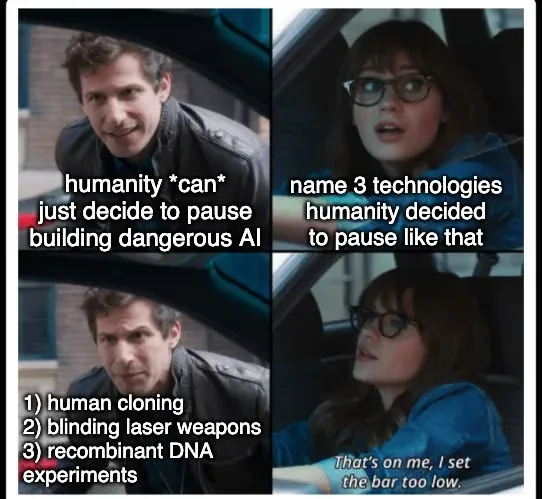
You know, the stuff we looked at, said "this is killing us," and collectively agreed to stop. Revolutionary concept.
The implication hanging in the air like vape smoke at a YC demo day: why can't we do that with AI?
The timing is chef's kiss. This week we got:
- The Pope dropping an encyclical warning about "opaque algorithms" causing "new forms of dehumanisation" (23,955 upvotes, even the Catholics are scared)
- WSJ reporting "The American Rebellion Against AI Is Gaining Steam" with booed commencement speakers and blocked data centers
- Microsoft quietly confirming what every CFO suspected: using AI is more expensive than paying humans (19,675 upvotes for the reality check)
- WiFi that can now identify you with "near perfect accuracy" because of course it can
- Ex-Facebook exec Sheryl Sandberg telling Gen Z the 10-year career plan is dead—thanks AI!—as if she's helping
And yet OpenAI's response to their reasoning model allegedly finding a counterexample to Erdős's unit-distance bound? Keep shipping. Anthropic's response to safety concerns? Keep shipping. Google's response to their AI Overview telling people to eat rocks? Keep shipping, but maybe add a disclaimer.
THE PAUSE BUTTON THAT WORKED
Here's what's genuinely fascinating about the "things we paused" list. Each item shares three characteristics:
Visible body count: People were demonstrably dying or getting sick. The ozone hole was measurable. Lead poisoning had symptoms you could see.
Concentrated industry opposition: CFC makers fought regulation. Lead additive companies ran smear campaigns. Asbestos industry funded fake science. Sound familiar?
Regulatory teeth: We didn't ask nicely. We banned shit. The Montreal Protocol wasn't a voluntary pledge signed by chemical companies promising to "self-regulate responsibly."
Now contrast that with AI in 2026. The harms are diffuse. The industry opposition is funded by $100B+ in venture capital. And regulation? Congress has held approximately 847 hearings titled "Understanding AI" and passed roughly zero laws with actual enforcement mechanisms.
THE COST REALITY CHECK
Here's the detail the hype brigade doesn't want you internalizing from that Microsoft report: AI is expensive as hell. Not "eventually it'll be cheap" expensive. Right now, today, using GPT-4 or Claude for production workloads costs more than hiring humans to do the same task.
We're talking $10-60 per million tokens for the good models. A mid-tier content operation running AI agents at scale? Easily $50K-200K/month in API costs. For that price, you could hire 3-8 experienced humans with benefits.
But the pause conversation isn't about economics. It's about the weird collective delusion that this time is different—that the same species that couldn't pause social media algorithmic radicalization, couldn't pause smartphone addiction, couldn't pause the enshittification of every digital platform, will somehow pause artificial general intelligence because... Sam Altman signed a letter?
THE UNSPOKEN PROBLEM
Here's what nobody in the AI safety discourse wants to admit: we didn't "pause" CFCs because we were smart. We paused them because the alternatives were cheaper. HFC replacements were waiting in the wings. Unleaded gas was already viable. The market incentives aligned with survival.
With AI? The incentives are inverted. Every company racing toward AGI is sitting on billions in funding that requires them to ship faster. OpenAI needs to justify that $86B valuation. Anthropic needs returns on that $7.3B raise. Google needs to prove it can still innovate. Meta needs... actually nobody knows what Meta needs, Zuck just wants to win something.
The pause isn't coming. Not because we shouldn't. Because the capital structure won't allow it.
Wozniak got cheers this week for telling students they have "actual intelligence." That's where we are in 2026—cheering for the reminder that humans can think. The Pope is writing encyclicals about algorithms. Town councils are proposing bans on the internet because surveillance tech scared them that badly.
And somewhere in San Francisco, another AI startup just raised $40M to build "responsible AI agents" that will definitely, probably, almost certainly not replace your job. Until they do. And then we'll all look back at that Reddit post and think: we should have paused.
But we won't. Because we never do. Not when the hype is this good and the money is this fast.
The real "humanity's greatest hit" isn't that we paused things. It's that we keep not pausing things until the damage is undeniable. By then, with AI, the question won't be whether we can hit pause. It'll be whether the pause button still exists.