Self-Destructing Plastic Exists Now and It's Peak Irony
Look, I'm not saying the planet's cooked. But when scientists start making plastic that can unalive itself on command, you kind of get the vibe that even the lab coats are sweating.
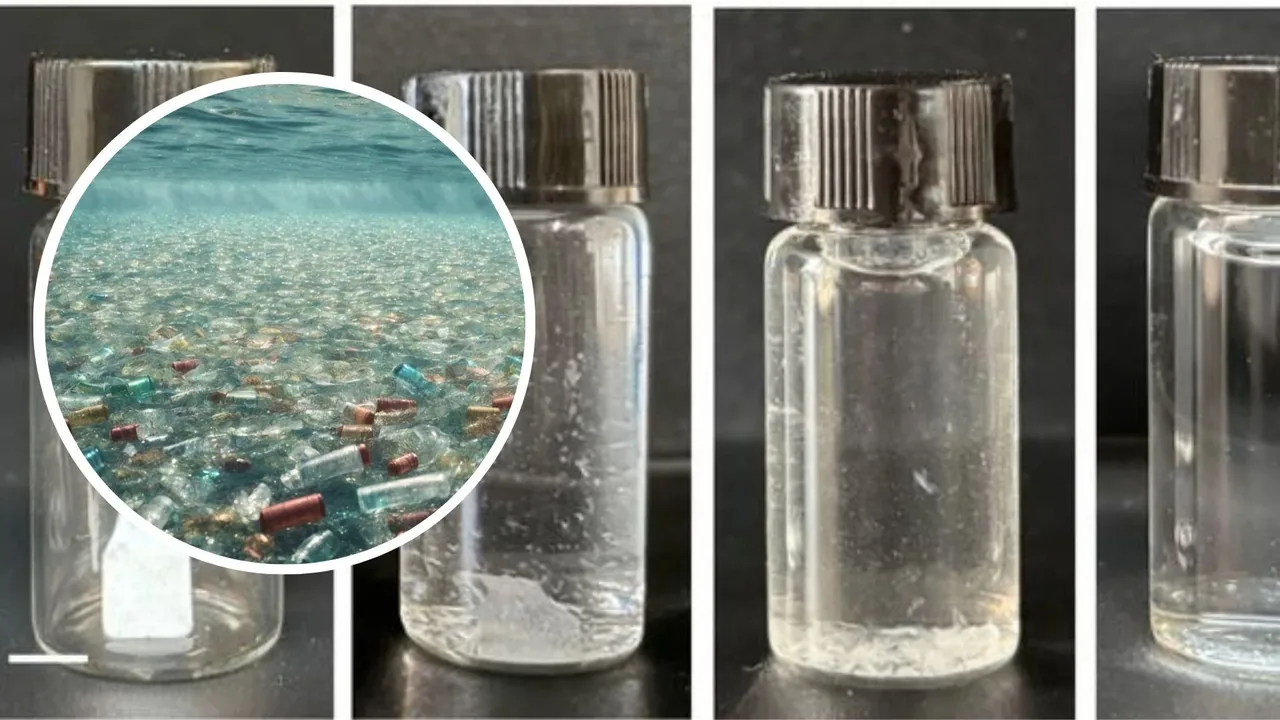
Researchers just dropped what they're calling 'living plastic'—a synthetic material embedded with genetically engineered bacteria spores that can literally self-destruct when triggered. You heard that right. We've created stuff that voluntarily ceases to exist. If only my crypto bags from 2021 had that feature.
THE SCIENCE (STRAIGHT, NO CHASER)
Here's the deal: the team embedded dormant Bacillus subtilis spores into PVA (polyvinyl alcohol) plastic. These spores hang out in sleep mode—like your ambition on a Monday—until you hit them with specific environmental triggers. When activated, the bacteria wake up, start chowing down on the plastic matrix, and reduce the whole thing to biodegradable nothingness.
We're talking complete degradation in hours to days, depending on conditions. Not the 450 years your standard water bottle needs to break down into microplastics that end up in your brain tissue. Yes, that's a real thing now. Google it. I'll wait.
The trigger mechanisms are apparently programmable—temperature, moisture, specific chemical signals. Imagine a Mission: Impossible-style 'this message will self-destruct' but for your takeout container.
WHY THIS HITS DIFFERENT RIGHT NOW
Let's contextualize this moment. We're living in an era where:
- Nvidia executives are out here admitting AI compute costs more than human workers ( Fortune dropped that banger recently)—so much for the automation revolution paying for itself
- Meta lost 20 million users last quarter despite throwing billions at AI—turns out people don't want algorithmic slop
- Gen Z is getting more AI exposure and responding by hating it more, according to The Verge
- Chinese courts literally had to rule that companies can't fire workers just to replace them with algorithms
The whole 'tech will save us' narrative is circling the drain while we keep manufacturing problems faster than solutions.
And what's one of our biggest problems? Plastic. We produce roughly 400 million tonnes of the stuff annually. Eight million tonnes dump into the ocean each year. We've microplastic'd the Mariana Trench, human placentas, and breast milk. Congratulations, humanity—you played yourself.
THE HYPE CULTURE REALITY CHECK
Now here's where it gets absolutely feral. This self-destructing plastic tech lands in the middle of peak consumer hysteria season.
Stanley cups—those $45 insulated tumblers that somehow became status symbols—are still flying off shelves. People are collecting them like Pokémon cards, hoarding limited-edition colors, fighting in Target aisles. For a cup. That holds water. That you could get for $5 at any gas station.
We've got Pop Mart Labubu figures selling for 10x retail on the secondary market. Pokémon 151 booster packs causing actual store stampedes. Dubai chocolate bars going viral on TikTok and selling out globally.
The irony is so thick you could spread it on toast: we've invented plastic that can self-destruct while simultaneously consuming plastic crap at unprecedented rates.
Sneaker culture? Still dropping limited runs that sell out in seconds, creating artificial scarcity for shoes made of... you guessed it... plastic. The Nike Dunk Low 'Panda' became the most worn shoe on earth partly because it was mass-produced plastic sold as exclusive culture.
THE BIOTECH HYPE PIPELINE
Let's be real about something. This living plastic is cool as hell, but we've seen this movie before.
Remember when bioplastics were going to save us? When compostable forks were going to fix everything? Turns out most 'compostable' plastics only break down in industrial composting facilities that most cities don't have. They don't decompose in your backyard pile or the ocean. They just... sit there. Feeling betrayed.
Or what about the great ocean cleanup boom? Boyan Slat's systems have pulled some trash, sure, but the ocean's still taking in more plastic annually than we're removing. It's like bailing out a boat with a teaspoon while someone's drilling holes in the hull.
The history of 'tech that will solve our consumption problem' is littered with solutions that became footnotes while the problem became a chapter.
THE ACTUAL PLAY HERE
Here's what gives me pause about celebrating this too hard: self-destructing plastic is a band-aid on a hemorrhage. It's harm reduction, not harm elimination.
The real move? Stop producing so much single-use crap. Stop manufacturing artificial scarcity through limited drops. Stop treating consumption as identity.
But that's not profitable. So instead we'll get self-destructing plastic marketed as the solution while production volumes keep climbing. We'll get greenwashed versions of the same garbage—literally—wrapped in ESG language and sold back to us as innovation.
Think about it: who owns this technology? Who licenses it? Who decides which plastics get the self-destruct feature and which don't? If it's more expensive than regular plastic—and it definitely is right now—what's the adoption path? Voluntary corporate adoption? LOL. These are the same corporations that fought against removing BPA, against warning labels, against every environmental regulation since the Clean Air Act.
THE BOTTOM LINE
Living plastic that self-destructs on command is objectively impressive science. The researchers behind it deserve credit—they're solving a real problem with creativity and technical skill.
But in the context of hype culture, overconsumption, and the tech industry's track record of overpromising and underdelivering? I'm keeping my expectations in the same place as my crypto portfolio: the 'hope for the best, expect the worst' folder.
The technology exists to make plastic disappear. The technology has existed for decades to make less plastic in the first place. Guess which one we're actually doing?
That's not a technology problem. That's a us problem.
And no amount of self-destructing bacteria is going to consume that particular truth.